Benchmarks
Field comparison against general-purpose and FASTQ-specific compressors on two
real Illumina RNA-seq runs spanning both quality regimes. Produced by the
harness in bench/, 4M-read subsets, 44 threads per tool, single node.
Long reads are measured separately, against CoLoRd.
How decompression throughput scales with thread count is measured separately in
Decode scaling.
Note
Ratios and throughput vary with data type (WGS vs RNA-seq), coverage, and
quality regime (full-range vs binned). Run the bench/ harness on your own
libraries before drawing conclusions.
Provenance
The Illumina tables were regenerated 2026-08-11 (4M-read R1 subsets, freshly
staged with sracha; not byte-comparable with subsets staged for earlier
revisions of this page) and the long-read tables 2026-08-12 at the v0.7.0
codebase. The Illumina tables are 4M-read subsets; the whole-file
per-dataset matrix — the source of the ratios quoted in the README, which are
higher because ratio grows with file size — lives in the repository's
bench/RESULTS.md, along with MiSeq, MGI/BGISEQ and miRNA rows this page
does not cover. Field-tool versions are whatever the repository's pixi.lock
pins for the bench environment (pixi list -e bench).
fqxv has three operating points, all lossless on sequence and quality and,
uniquely among the tools here, deterministic (byte-identical output
regardless of thread count):
fqxv(default) — fast, block-local, preserves everything.--max— deepest context + read reordering, still preserves read order and names exactly (a permutation is stored to restore order).--order shuffle— the reorder-lossy best-ratio point: reads come back as the same sequence+quality multiset but renumbered (original names and order discarded), so no permutation is stored. This is the same trade SPRING makes by default, and it is wherefqxvis smallest.
NovaSeq 6000, binned quality (DRR174812) — 4M reads, 572 Mbase
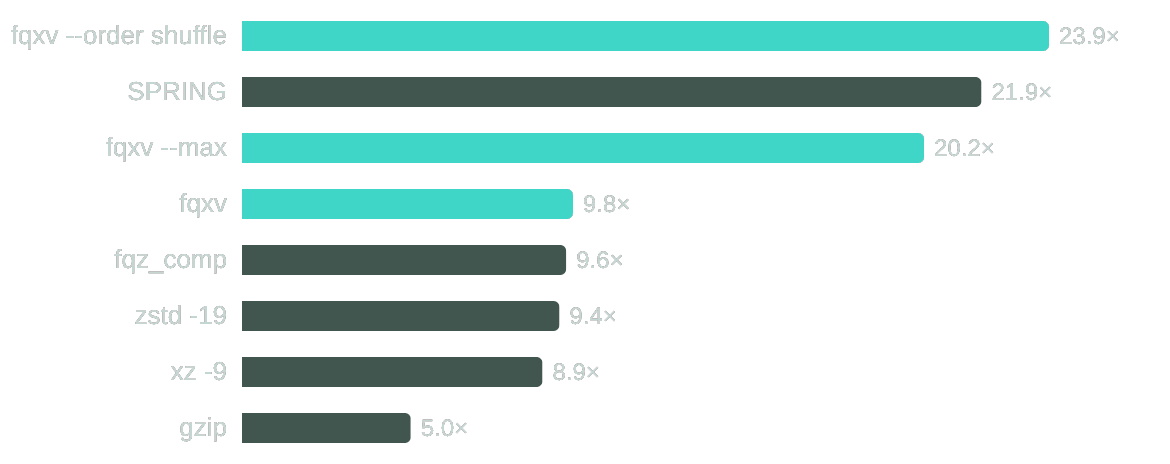
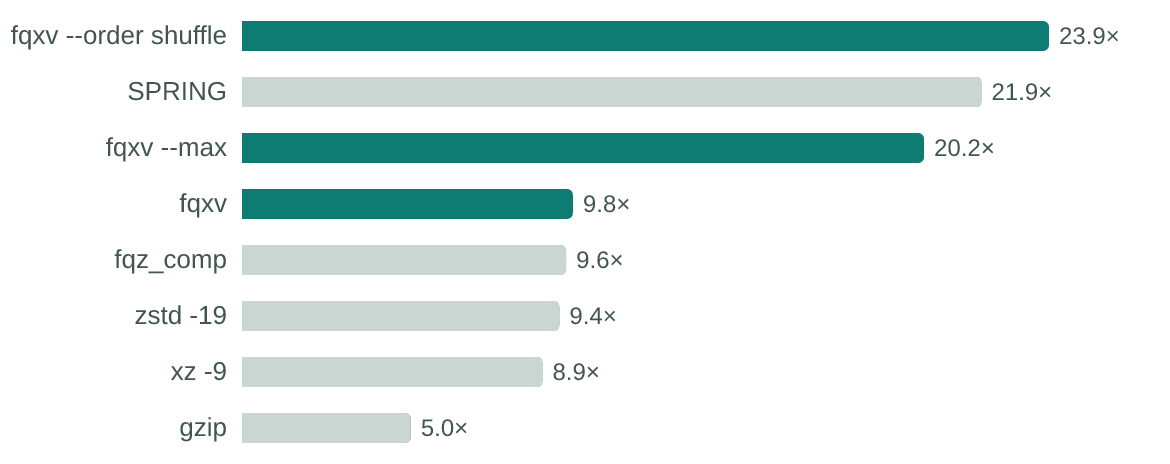
Compression ratio (higher is better); fqxv modes in teal. Full numbers below.
| Tool | Ratio | Compress | Decompress | Lossless | Deterministic |
|---|---|---|---|---|---|
fqxv --order shuffle |
24.0× | 20 MB/s | 137 MB/s | seq+qual (renumbered) | yes |
| SPRING | 22.0× | 71 MB/s | 137 MB/s | reordered | — |
fqxv --max |
20.4× | 21 MB/s | 118 MB/s | yes (order-preserving) | yes |
fqxv (default) |
9.9× | 116 MB/s | 110 MB/s | yes | yes |
| fqz_comp | 9.7× | 107 MB/s | 65 MB/s | no | — |
| zstd -19 | 9.5× | 11 MB/s | 283 MB/s | yes | — |
| xz -9 | 9.0× | 10 MB/s | 356 MB/s | yes | — |
| gzip | 5.0× | 380 MB/s | 173 MB/s | yes | — |
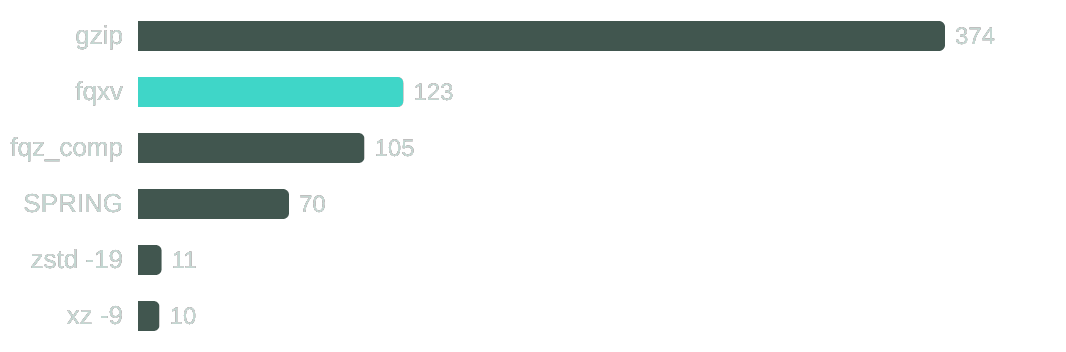
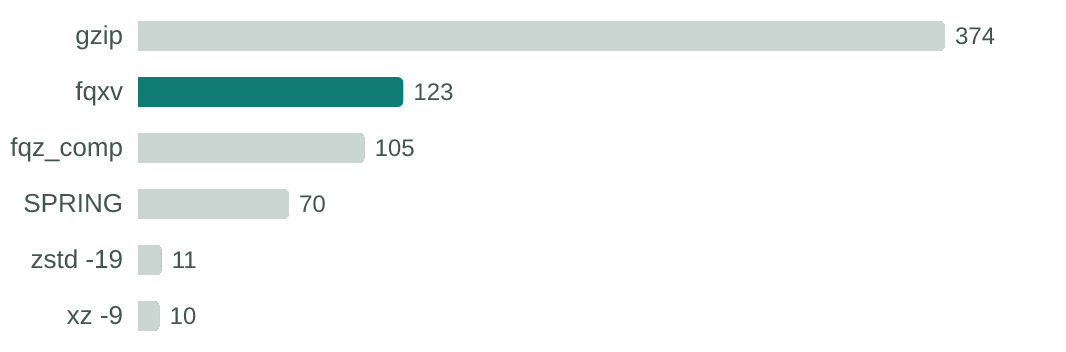
Compress throughput in MB/s at the default operating point (higher is faster); fqxv default in teal. Only gzip — far weaker on ratio — compresses faster, and fqxv is ~10× faster than zstd -19 / xz -9 while beating them on ratio.
GAIIx, full-range quality (SRR453566) — 4M reads, 385 Mbase
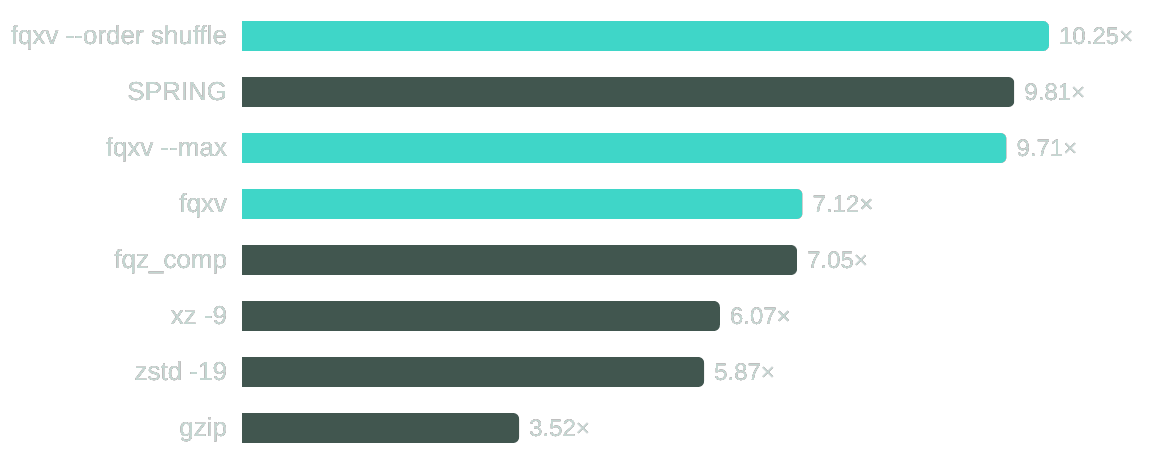
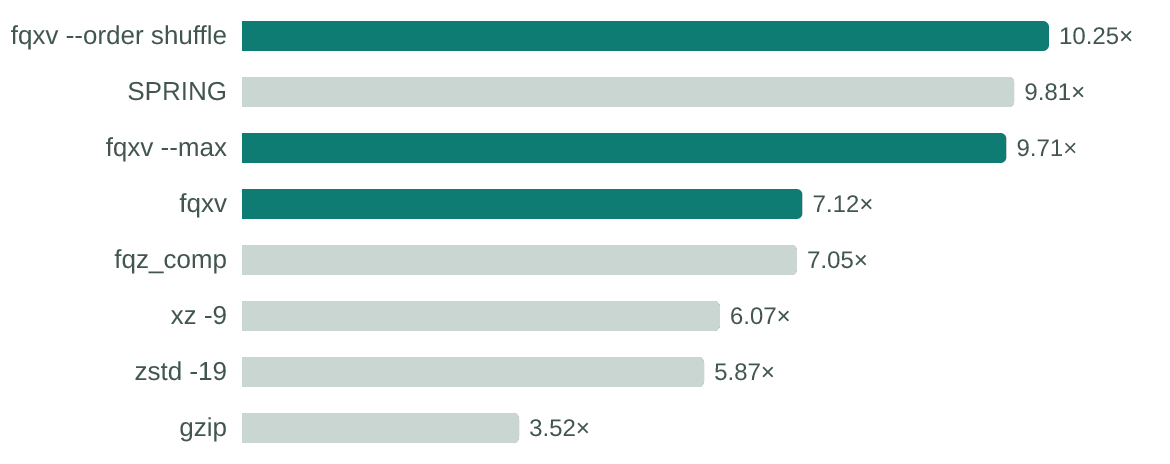
Compression ratio (higher is better); fqxv modes in teal. Full numbers below.
| Tool | Ratio | Compress | Decompress | Lossless | Deterministic |
|---|---|---|---|---|---|
fqxv --order shuffle |
11.97× | 22 MB/s | 202 MB/s | seq+qual (renumbered) | yes |
fqxv --max |
10.48× | 24 MB/s | 132 MB/s | yes (order-preserving) | yes |
| SPRING | 10.32× | 67 MB/s | 134 MB/s | reordered | — |
fqxv (default) |
7.80× | 140 MB/s | 138 MB/s | yes | yes |
| fqz_comp | 7.45× | 101 MB/s | 80 MB/s | no | — |
| xz -9 | 6.15× | 7 MB/s | 286 MB/s | yes | — |
| zstd -19 | 6.00× | 13 MB/s | 491 MB/s | yes | — |
| gzip | 3.77× | 414 MB/s | 166 MB/s | yes | — |
Reading the numbers
fqxv --order shuffleis the smallest lossless compressor here — it beats SPRING on both datasets (24.0× vs 22.0× on NovaSeq, 11.97× vs 10.32× on full-range), under the same rules SPRING plays by (reorder + renumber). SPRING keeps the original read names;fqxv --order shufflerenumbers, but the name stream is a rounding error either way (~a few KB on a 60 MB archive), so this is an apples-to-apples ratio win fromfqxv's sequence and quality coding. It does not hold everywhere: on the hardest short-read case in the wider matrix (MGI/BGISEQ,bench/RESULTS.md) SPRING is still smaller.fqxv --maxis the best-ratio fully lossless option — it additionally preserves original read order and names, which SPRING does not, and on the full-range set it now beats SPRING outright (10.48× vs 10.32×) despite that stronger guarantee. The guarantee costs a read-order permutation: on NovaSeq the--maxarchive is names 0.1 MB + sequence 42.7 MB (of which ~11 MB is the permutation) + quality 30.7 MB. Dropping just that permutation (via--order shuffle) is what takes the sequence stream from 42.7 MB to 31.3 MB and putsfqxvfurther ahead of SPRING.- Determinism and verified losslessness are
fqxv's alone here. Everyfqxvarchive round-trips its exact content (sequence+quality multiset, and names in the order-preserving modes) and is byte-identical across thread counts;fqz_compfails the content round-trip in this harness on both sets. - The default mode trades ratio for speed cleanly: still ahead of fqz_comp / zstd / xz on ratio, at ~115–140 MB/s — an order of magnitude faster to compress than zstd -19 or xz -9.
- Lossy quality is a separate tier.
fqxv --quality-bin bin8|bin4|bin2and SPRING'sill_bin/binarymodes quantize quality for more ratio; compare those against each other, not against the lossless rows above.
Long reads (ONT / PacBio)
Long-read FASTQ compresses correctly today — read lengths are u32 end to end,
blocks are cut by a raw-byte budget so ragged reads still parallelize, and the
short-read reorder codec auto-disables. Long-read blocks pick a sequence codec per
block from several candidates and keep the smallest (see
the sequence codecs below), so no block ever regresses
below the within-read order-k model.
The tables below measure each stream against CoLoRd -q org (its lossless quality
mode). fqxv's columns come from fqxv info, which reports its real streams; CoLoRd
has no such split, so its columns are taken by difference — -q none discards
quality, and quality is org - none. -q none still carries names and container
overhead, so CoLoRd's non-quality column is an upper bound on its sequence
stream, while fqxv's is the sequence stream alone. Sizes are decimal MB
(bytes ÷ 10⁶); bits/base is over the true base count.
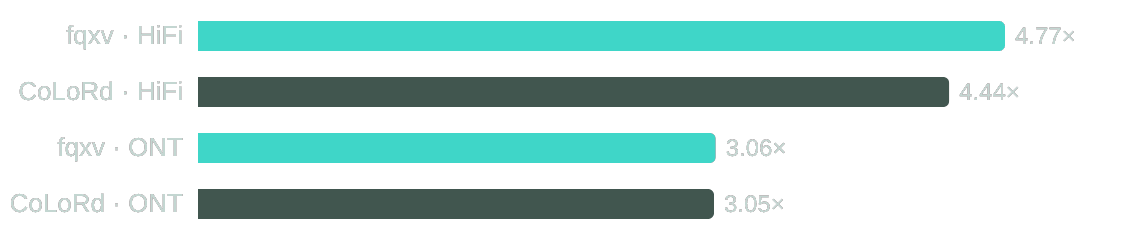
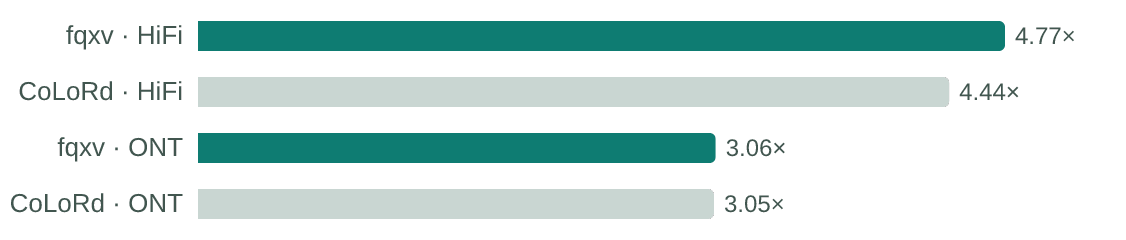
Whole-file lossless ratio vs CoLoRd -q org (higher is better); fqxv in teal.
fqxv now edges ahead on both platforms. Per-stream breakdown below.
ecoli_ont (DRR205413, 301 Mbase, 21,140 reads, mean Q≈11.5 — noisy older
basecaller):
| Tool | Total | Non-quality | Quality | Non-quality bits/base |
|---|---|---|---|---|
CoLoRd -q org |
197.9M | 31.4M | 166.5M | 0.84 |
fqxv -l9 |
197.1M | 33.4M (seq) | 163.7M | 0.89 |
ecoli_hifi (SRR11434954 subset, 1.55G bases, mean Q≈27, ~300×):
| Tool | Total | Non-quality | Quality | Non-quality bits/base |
|---|---|---|---|---|
CoLoRd -q org |
697.7M | 13.4M | 684.3M | 0.069 |
fqxv --max |
649.5M | 12.3M (seq) | 635.6M | 0.064 |
Default-level long-read archives now chunk quality
The fqxv rows above are the best-ratio serial layout (-l9/--max),
byte-identical across recent releases. Since v0.7.0 the default level
codes long-read quality in parallel-decodable chunks (context mode 5/6),
trading +0.36% (ONT) / +0.19% (HiFi) archive size for full decode
~1.9× faster at 16+ threads and HiFi compress 17% faster — see
Decode scaling. --max pins the serial
smallest-archive layout.
Two facts hold on both platforms:
- Quality beats CoLoRd on both platforms. fqxv's binary-decomposition, context-mixing quality coder codes the HiFi quality stream to 635.6M vs CoLoRd's 684.3M (~7% smaller) and ONT to 163.7M vs 166.5M (~2% smaller). On HiFi that quality win carries the lossless total ahead of CoLoRd (649.5M vs 697.7M, 4.77× vs 4.44× on the full file); on ONT fqxv edges ahead on the total too — 197.1M vs 197.9M (3.06× vs 3.05×).
- The sequence stream is no longer a blanket deficit. On HiFi Sequel II it is a credit (12.3M vs 13.4M) — the same locus is read hundreds of times at ~300×, and fqxv now assembles one whole-file consensus and codes each read against it. On ONT it is down to 33.4M vs 31.4M — ~6% behind on sequence (the anchor-restricted coder aligns only inter-anchor gaps), which the quality credit now more than closes. The one regime it still trails materially is ordinary-coverage HiFi (Revio WGS), which the raw-LZMA path below addresses. Each lever is described under the sequence codecs.
Compress speed. The long-read codecs are the compute-heavy part of fqxv, and
recent work cut that cost without touching the output: on a 16-thread node,
default-mode compress of the noisy ONT run is now ~3× faster (skipping an
always-discarded consensus candidate and the redundant shared-reference assembly
on Nanopore, and de-packing the alignment traceback), and HiFi is ~9% faster —
same archives, same ratios. The anchor-restricted tiler coder (#231) makes ONT
another 1.54× faster at 16 threads and smaller (it aligns only inter-anchor
gaps), and chunked quality (#279) makes default-level HiFi compress 17% faster
still (the chunks encode in parallel too). The deepest sequence lever (best-of-N
tiling references) stays gated to --max, so the default stays fast and --max
buys the extra ratio only when you ask for it.
Lossy quality
--quality-bin ont cuts the ONT quality stream by ~3.5× (mean |Δ| 3.35). Binning
removes the stream fqxv is best at and leaves sequence dominant, so the platform
match matters — see Lossy quality binning.
colord-lossy is still smaller on the aggressive long-read lossy points.
The sequence codecs
Long-read blocks are coded by up to four sequence methods and the smallest is
kept per block, so selection is automatic and a block can never regress below the
within-read order-k model. All are clean-room Rust, byte-identical across thread
counts, and every archive round-trips (per-block content digest plus
compress --verify). Three of them are the long-read levers, each tuned to a
different coverage/error regime:
- Shared whole-file overlap reference — the high-coverage HiFi lever
(
fqxv-lroverlap: minimizers → overlaps → consensus → per-read banded edit script → rANS). The container assembles one consensus over the whole file, stores it once in a framed region before the first block, and codes every block's reads against that frozen frame — so a read codes identically no matter which block holds it, and blocks stay independently decodable. Onecoli_hifi(120k reads, 1.55 Gbase, ~300×) this puts the sequence stream at 0.064 bits/base, past CoLoRd's 0.069 — a ~10× shrink over the within-read model. Storing the reference once instead of per block was the whole gap. - Raw large-window LZMA — the ordinary-coverage lever, and the biggest change
this cycle. A real genome at typical (not 300×) coverage carries exact
cross-read matches that neither the within-read model nor a per-block voted
consensus can reach. On the modern Revio WGS run (
hifi_revio_wgs, SRR36938642, 1.35 Gbase) it cuts the sequence stream from 1.391 to 0.683 bits/base, taking the whole archive from 9.7× to 17× — from the worst lossless result in the suite to a strong second behind CoLoRd (18.8×), now ahead of both zstd -19 and xz -9. - Multi-reference tiling + anchor-restricted coding — the Nanopore lever. Each
read is coded against earlier raw reads with best-of-N reference selection
(engaged at
-l9/--max), which pays where a read sits closer to another single read than to a divergent consensus — the ~10% ONT-error regime. Rather than re-aligning the whole read, the coder seeds minimizers, chains them, and aligns only the short inter-anchor gaps (CoLoRd-style) — both faster and tighter. Together they cut-l9ONT sequence to 0.887 bits/base, bringing the ONT total ahead of CoLoRd (3.06× vs 3.05×).
See Long-read support for the full analysis.
Storage vs the native NCBI .sra
Most public FASTQ ships as NCBI's .sra — itself a compressed columnar store
(2-bit-packed bases, a quality model, spot/name columns). So for anyone pulling
from SRA/ENA the honest question is not "fqxv vs gzip" but "is a lossless .fqxv
worth keeping instead of the .sra I'd otherwise store?" It is: fqxv --max
(fully lossless) is smaller than the native .sra on every platform — ~2× on
average (geomean 0.51 of the .sra size).
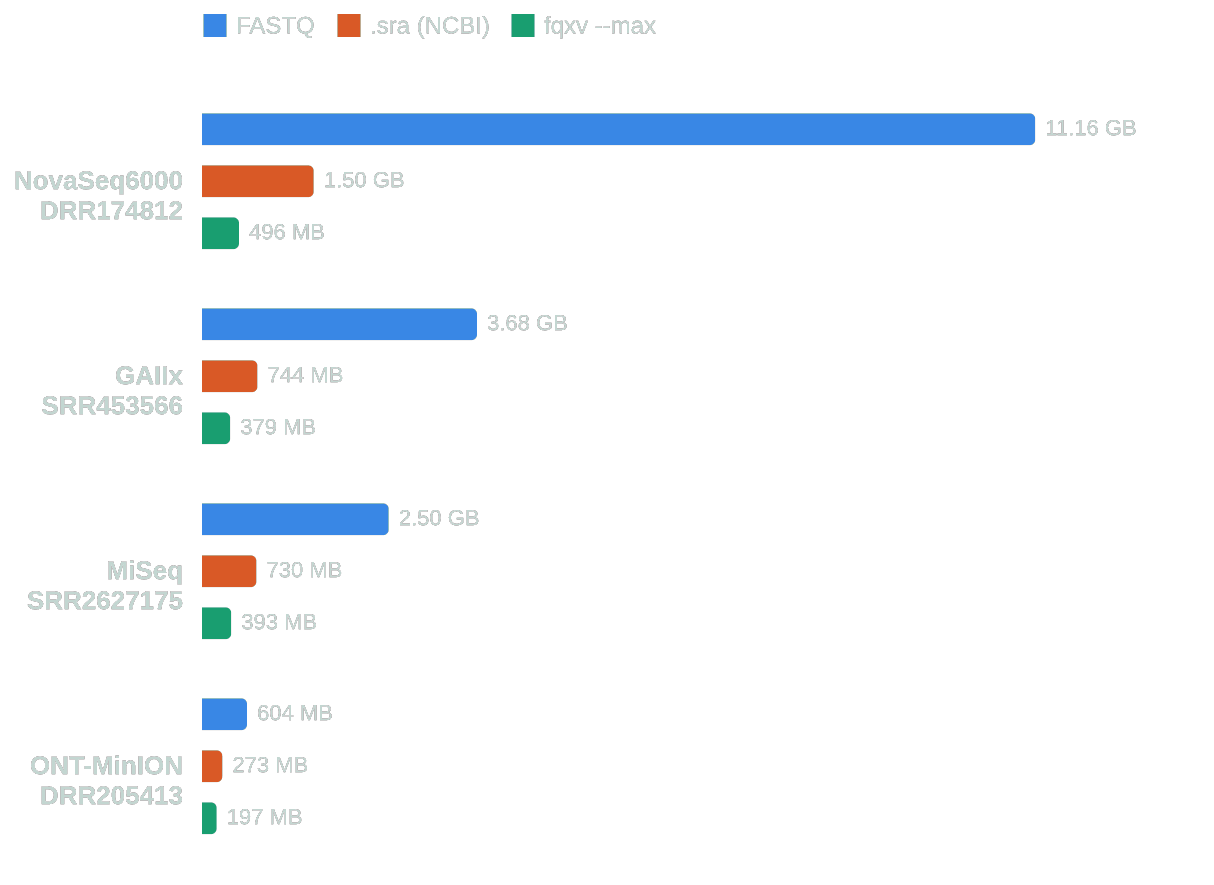
Storage per run in each format (smaller is better): the raw .fastq you
download, the native .sra NCBI ships, and the lossless fqxv --max archive.
Both mates counted; .sra sizes from sracha info. NovaSeq wins most (its
quality is pre-binned, so the lossless point is already compact); ONT wins least
(its long-read sequence stream dominates the archive). Refreshed 2026-07-23 —
regenerate with bench/scripts/sra_compare.sh.
Round-trip fidelity (alignment level)
A compression ratio only counts if the reads survive intact. Beyond fqxv's
internal round-trip digest, the bench/scripts/bam_identity.sh harness proves fidelity
through a real analysis: it aligns the original reads and the fqxv
round-tripped reads with bwa mem and compares the BAMs with an order-independent
multiset digest (bench/tools/bamcmp.rs).
On E. coli MiSeq (SRR2627175, 2.19 M reads, GCF_000005845.2):
| Mode | BAM vs original | Detail |
|---|---|---|
| lossless (default) | byte-identical | every field, including the coordinate-sorted file |
--order any / --order shuffle |
byte-identical | output order preserved on real SRA data |
--quality-bin bin8 |
reads unmoved; QUAL only | mean |Δ| 1.10, max 4 Phred (72.7% of bases) |
--quality-bin bin4 |
reads unmoved; QUAL only | mean |Δ| 2.79, max 10 Phred (96.7%) |
--quality-bin bin2 |
reads unmoved; QUAL only | mean |Δ| 1.90, max 13 Phred (78.0%) |
- Lossless is byte-identical at the BAM level, not just the FASTQ: placement (FLAG/POS/MAPQ/CIGAR/SEQ), quality, and read names all match.
- Lossy quality binning never moves a read. Placement is identical for every bin; only the quality string changes, by a bounded amount.
Read order is load-bearing
A control that shuffles the identical read set (same multiset, verified by
fqdigest) and realigns shows bwa mem itself placing ~1.2% of reads
differently — deterministically, independent of thread count and unaffected
by -K. So a reproducible BAM depends on preserving read order, which fqxv
does by default and in its --max mode on real data. This is an aligner
property, not a fqxv effect: the reads going in are byte-identical.
Codecs
Every codec is clean-room, pure Rust — there is no external/C compressor
dependency. The reordered sequence path assembles a shared reference over the
clustered reads and codes each read as a position on it; the reference itself is
2-bit-packed and coded with a clean-room LZMA (or the order-k fqxv-seq model,
whichever is smaller), split into fixed blocks compressed in parallel. Quality is
a fqzcomp-class context model coded over only the quality levels that occur.
Assembly, the overlap-merge, the reference coder, and the per-block codecs all fan
out with rayon, and every stage uses fixed, thread-independent boundaries so
output never depends on the thread count.