Understanding Move Tables
Move tables are the foundation of dwell time feature extraction in leech. They encode how raw nanopore signal maps to basecalled sequence, enabling computation of per-base dwell times that distinguish one class of base from another -- for example, charged from uncharged tRNAs, the example used throughout this page.
Move table overview
The figure below illustrates how leech extracts dwell times from move tables:
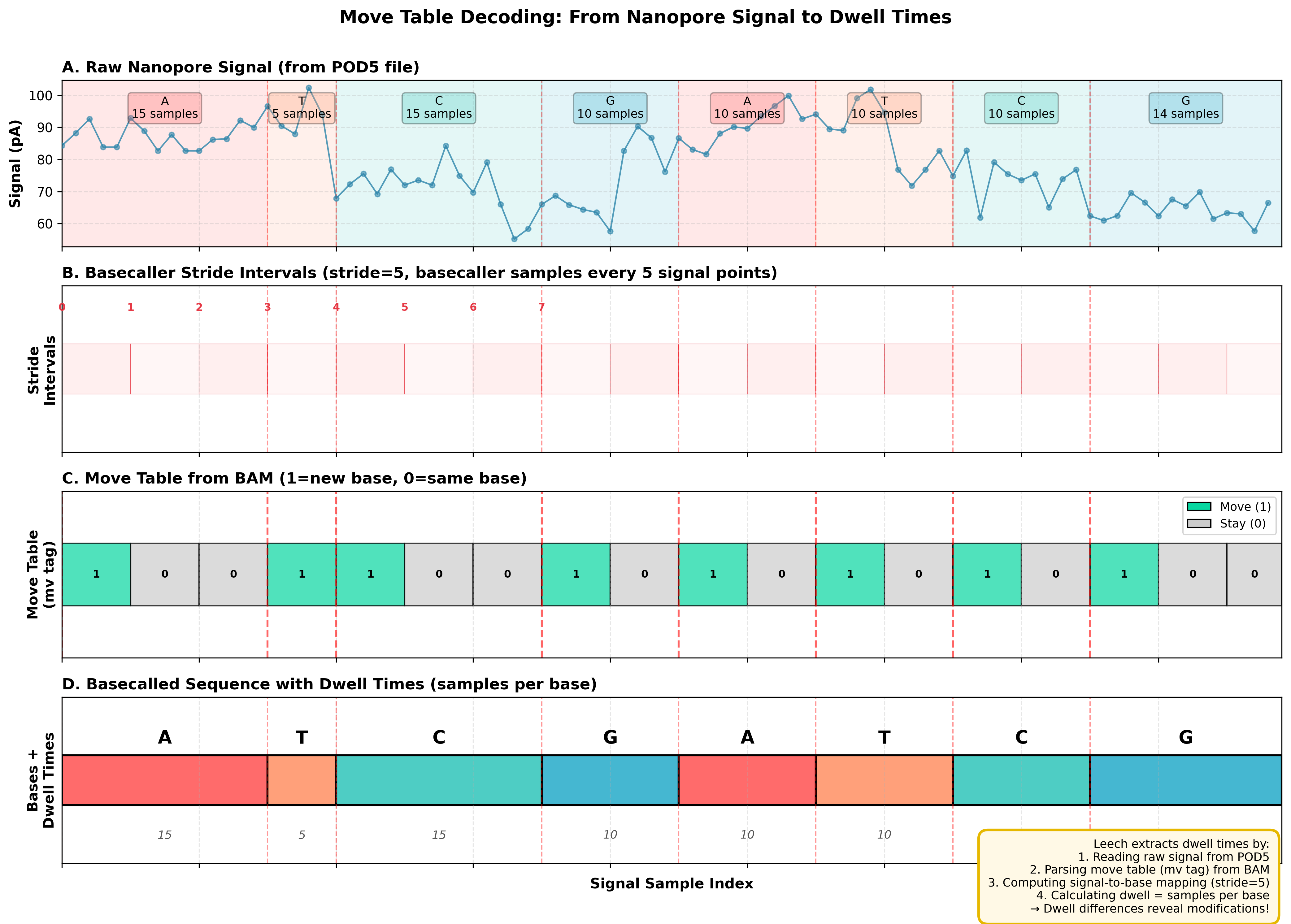
Panel A shows the raw nanopore signal with colored regions indicating different bases. Panel B displays stride positions where the basecaller samples the signal. Panel C shows the move table (from BAM mv tag) with 1s indicating new bases and 0s indicating the pore is still reading the same base. Panel D combines the sequence with per-base dwell times calculated from the move table.
Chemically modified bases -- for example, aminoacylation ("charging") of a tRNA -- often exhibit different translocation kinetics through the nanopore, resulting in distinctive dwell time patterns that leech models can learn to recognize.
Nanopore signal and basecalling
Oxford Nanopore sequencers sample ionic current at 4000 Hz as a nucleic acid strand translocates through the pore. The measured current at any instant depends on the ~5--9 bases occupying the pore (the k-mer context), not a single base. This k-mer dependence means that each base influences multiple consecutive signal samples, and the signal at any position reflects contributions from neighboring bases.
Translocation speed is not constant. The motor protein ratchets the strand through the pore one base at a time, but the time spent on each base (the dwell time) varies depending on sequence context, secondary structure, and chemical modifications. A basecaller (e.g., Dorado) processes the raw signal and produces both the base sequence and a move table recording which signal positions correspond to base transitions.
Move table format
The move table is stored in BAM files as the mv tag. Its structure:
- First element: the stride, which is the basecaller's downsampling factor (typically 5 for Dorado, though some configurations use 6 or 8)
- Remaining elements: a binary array where
1marks the start of a new base and0means the current base continues
The ns tag stores the total number of signal samples for the read. An
optional ts tag records the number of signal samples trimmed from the
start (the adapter/primer region).
Computing dwell times
To convert a move table into per-base dwell times:
- Extract the stride from
mv[0]and the binary moves frommv[1:] - Find positions where
move == 1(base boundaries) - Convert move-space positions to signal-space:
signal_idx = position * stride(plustrim_offsetfor untrimmed signal). This follows the Remora conventionnp.nonzero(mv)[0] * stride. The total sample count (nstag) is appended as the final boundary. - Compute dwell as the difference between consecutive signal indices
Worked example
Given a move table and 35 signal samples:
The moves array is [1, 0, 0, 1, 1, 0, 1]. Positions where move == 1 are
indices 0, 3, 4, and 6.
Converting to signal indices (position × stride, with the total sample
count appended as the final boundary):
| Move index | Signal index | Base |
|---|---|---|
| 0 | 0 × 5 = 0 | A |
| 3 | 3 × 5 = 15 | T |
| 4 | 4 × 5 = 20 | C |
| 6 | 6 × 5 = 30 | G |
| (end) | ns = 35 | -- |
Per-base dwell times (differences between consecutive signal indices):
| Base | Signal range | Dwell (samples) |
|---|---|---|
| A | 0--15 | 15 |
| T | 15--20 | 5 |
| C | 20--30 | 10 |
| G | 30--35 | 5 |
At 4000 Hz, these correspond to 3.75 ms, 1.25 ms, 2.50 ms, and 1.25 ms respectively. The variation in dwell times across bases reflects differences in translocation kinetics at each sequence context.
In leech, the MoveTable class in features.py handles this conversion:
Example: aminoacylation and the CCA tail
The rest of this page is generic to any modified-base or motif-centered classification task; this section works through the concrete tRNA charging example. Aminoacylation (charging) of a tRNA attaches an amino acid to the 3' CCA tail. This chemical modification alters the tRNA's physical properties as it passes through the nanopore, producing measurable changes in dwell time at and near the attachment site.
A typical dwell pattern comparison at the CCA motif:
| Position | Uncharged (samples) | Charged (samples) |
|---|---|---|
| C | 10 | 10 |
| C | 12 | 12 |
| A | 11 | 18 |
| (3' end) | 10 | 15 |
The increased dwell at the CCA tail in charged tRNAs reflects the attached amino acid's effect on translocation kinetics. Different amino acids produce distinct dwell signatures depending on their size, charge, and hydrophobicity, which forms the basis for amino acid discrimination.
Practical considerations
Edge cases
Reads may begin or end in the middle of a base. Leech requires sufficient context on both sides of a motif site (default: 200 signal samples left/right, 5 bases for k-mer context). Chunks that cannot satisfy this context requirement are discarded.
Indels at motif sites
When using reference-based motif search, leech maps motif positions from the
reference to query coordinates via the CIGAR string. If the alignment contains
insertions or deletions within the motif region, the mapping may be unreliable.
The --skip-motif-indels flag filters out such reads. This is class-selective (disrupted junctions are far more common in charged tRNAs), so it biases the class balance; check the per-class attrition data prepare reports.
Stride variations
The stride is automatically detected from the first element of the mv tag.
Common values:
| Basecaller | Stride |
|---|---|
| Dorado (default) | 5 |
| Dorado (alt) | 8 |
| Guppy | 5 |
No manual configuration is needed; leech reads the stride from each BAM record.
Required BAM tags
For leech to extract dwell features, BAM records must contain:
mv-- the move table (required)ns-- total number of signal samples (required)ts-- trim offset in signal samples (optional; defaults to 0)
These tags are produced by Dorado and Guppy when run with move table output enabled.