🌶️ sracha 🌶️

Fast SRA downloader and FASTQ converter, written in pure Rust.
Features
- Parallel downloads -- chunked HTTP Range requests with multiple connections
- Native VDB parsing -- pure Rust, zero C dependencies
- Integrated pipeline -- download, convert, and compress in one command
- cSRA decode -- reference-compressed / aligned SRA archives decoded in pure Rust
- ENA fast path --
--prefer-enapulls pre-computed FASTQ.gz from ENA when available - Project-level accessions -- pass a BioProject (PRJNA) or study (SRP) to download all runs
- Accession lists -- batch download from a file with
--accession-list - Parallel gzip or zstd -- pigz-style block compression via rayon
- FASTA output -- drop quality scores with
--fasta - SRA and SRA-lite -- full quality or simplified quality scores
- Split modes -- split-3, split-files, split-spot, interleaved
- Stdout streaming -- pipe interleaved FASTQ to downstream tools with
-Z - Resumable downloads -- automatically resumes interrupted transfers
- File validation -- verify SRA file integrity with
sracha validate - VDB introspection --
sracha vdbinspects.sraarchives (tables, columns, metadata, schema) as a pure-Rust replacement forvdb-dump, either from a local file or straight from an accession over HTTP range requests, no download needed
How it works
sracha get runs the full pipeline in one command:
- Resolve -- looks up the accession via direct S3 URL (with SDL API fallback)
- Download -- fetches the
.srafile with parallel chunked HTTP Range requests - Parse -- reads the KAR archive and decodes VDB columns (READ, QUALITY, READ_LEN, NAME)
- Output -- formats FASTQ (or FASTA) records and compresses with parallel gzip/zstd
Demo
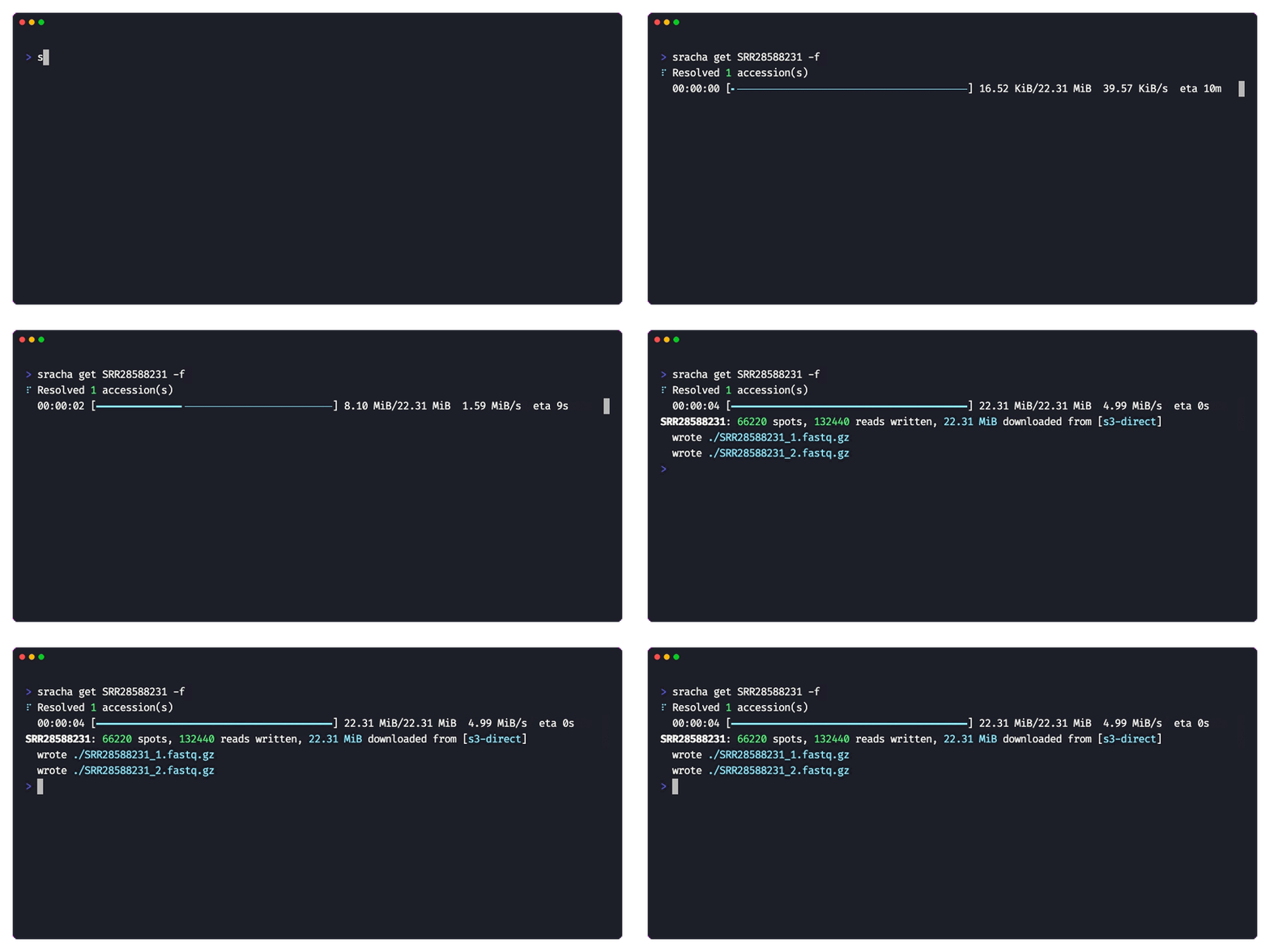
Quick start
See the Getting Started guide for more examples, or the CLI Reference for all options.
Installation
From binary releases
Download pre-built binaries from the
releases page, which covers
Linux (x86_64, aarch64), macOS (Intel, Apple silicon), and Windows (x86_64).
Unix targets ship a .tar.gz; Windows ships a .zip holding a single
statically linked sracha.exe with no runtime to install.
On Linux and macOS x86_64, pick the -v2 build unless you know the host has
AVX2, in which case -v3 decodes faster. ARM and Windows builds ship a single
binary.
From source
Requires Rust 1.95+.
With Bioconda
Bioconda builds for Linux (x86_64, aarch64) and macOS (Intel, Apple silicon)
only — it has no Windows channel, so this and the container images below are
not available on Windows. Use the release .zip, cargo install, or WSL2.
With containers
Because sracha is on Bioconda, BioContainers automatically publishes a Docker/Singularity image for every release — no local build required.
These tags track the current Bioconda release and are refreshed weekly by a
CI job. BioContainers builds an image a day or two behind a new release, so
just after a release the tag here may still name the previous version — see
quay.io for every
published <version>--<build> tag.
Nextflow
In Nextflow, point a process at the image directly
or let the conda directive resolve it:
Pin the version for reproducibility, as above. Dropping the version from the
conda directive (conda 'bioconda::sracha') resolves to whatever is current
in Bioconda instead, which is convenient for ad-hoc runs but makes the
pipeline non-reproducible.
Acknowledgments
sracha builds on the Sequence Read Archive, maintained by the National Center for Biotechnology Information at the National Library of Medicine. The SRA and its toolchain are public-domain software developed by U.S. government employees — our tax dollars at work. Special thanks to Kenneth Durbrow (@durbrow) and the SRA Toolkit team for building and maintaining the infrastructure that makes projects like this possible.
This project wouldn't exist without NCBI's open infrastructure: the VDB/KAR format, the SDL locate API, EUtils, and public S3 hosting of sequencing data. sracha aims to make it easier for the community to build on that foundation.